
Home Harassment duty
The sexual harassment duty, in plain English
The Equality and Human Rights Commission's free guidance tells you what to do. This kit gives you the ready-to-edit policy, scripts and records to do it in a pub, café or B&B.
Plain-English templates · Sources linked to legislation.gov.uk and EHRC · 30-day no-quibble refund · Help by email: bayadmin@mail.grokbot.com
Free sample: see the policy pages first
30 October 2026
From 30 October 2026
From 30 October 2026, employers must take all reasonable steps to prevent sexual harassment of their staff.
Employers must not permit harassment of staff by customers and other third parties.
Full kit £79. The price goes up after 30 October.
Not legal advice.
For people who run a pub, café or small hotel in England and Wales. What has been required since 26 October 2024, what changes on 30 October 2026, and five practical steps.
This is general information for busy owners, not legal advice. For the official position, read the GOV.UK page on workplace bullying and harassment, the GOV.UK note on the October 2024 protections, the EHRC technical guidance on sexual harassment at work, and the EHRC 8-step guide for employers.
What changed on 26 October 2024
On 26 October 2024 the Worker Protection (Amendment of Equality Act 2010) Act 2023 came into force. It put a preventative duty on employers. If you employ people, you must take reasonable steps to prevent sexual harassment of your workers.
A few points that matter in a pub, café or hotel:
- The duty is proactive. You do not wait for an incident and then write a policy.
- It covers harassment by colleagues, and by third parties such as customers. The Equality and Human Rights Commission says the preventative duty includes customers and other members of the public.
- Sexual harassment has a legal meaning: unwanted conduct of a sexual nature that has the purpose or effect of violating someone’s dignity, or of creating an intimidating, hostile, degrading, humiliating or offensive environment.
- If the duty is missed, the EHRC can take enforcement action. If a worker wins a sexual harassment claim, the tribunal must consider the duty and can increase compensation by up to 25%.
What counts as reasonable depends on the size of the business and the risks in it. A small site is not held to the same programme as a hotel group. It is still expected to have done something real.
What changes on 30 October 2026
From 30 October 2026 the duty moves from “reasonable steps” to “all reasonable steps”. The change is in the Employment Rights Act 2025 (sections 20 and 21, in force on 30 October 2026 under SI 2026/1065). Acas puts it this way: employers will be expected to take all of the steps that are reasonable for their organisation, not a selection of them.
In practice, a tribunal or the EHRC can ask whether there was another reasonable step, for a business of your size, that you did not take.
From the same date, an employer can be liable for harassment of staff by third parties, such as customers, unless it took all reasonable steps to prevent that harassment. The 2024 duty already expected you to try to stop it. The 2026 change is about that liability, and about the higher test.
Ministers can make regulations that list steps which count as reasonable. Those regulations are not expected straight away. Until they exist, the documents to read are the EHRC technical guidance, the EHRC 8-step guide, and the Acas pages for employers. The Act itself is on legislation.gov.uk.
Five practical steps
This is a starting list for a small site, not a full statement of the duty. The EHRC guide has eight steps. Read that as well.
-
Write down the risks in your own place
Late bar shifts, the kitchen pass, a lock-in, a staff party, phones and group chats, a guest alone with a housekeeper, someone working the close on their own. Note where sexual harassment could come from colleagues and from customers. A page of honest notes is more use than a generic form with every box marked low.
-
Put a short policy where staff will see it
Say that sexual harassment is not accepted, that this includes customers as well as colleagues, how to report it, and what you will do next. Put it in the induction, not only in a folder nobody opens.
-
Give people a way to report that is not only their manager
In a small business the manager may be the owner, or may be the problem. Name a second person, or a route such as Acas, and say that staff will not be punished for raising a concern in good faith.
-
Brief the people who run shifts, and keep a record
They need to know what to say if a customer crosses a line, how to get a colleague off the floor, and when to refuse service. Note who was briefed and when. A signature, or a dated line, is enough.
-
Look at it again
Once or twice a year, and after any incident, check whether the risks or the team have changed. Write down what you changed. A policy from 2024 that nobody has reread is a weak answer to “all reasonable steps”.
Questions owners ask
Does this apply to a small pub, café or hotel?
Yes, if you employ people. The preventative duty sits on employers, including small ones. There is no staff-number threshold in the duty. What counts as a reasonable step does depend on your size and on the risks in your workplace. A café with three staff is not expected to run a corporate training programme. It is expected to have thought about the risk and taken the steps that are realistic for it.
Does the duty cover customers, not only colleagues?
The duty protects your workers. It includes sexual harassment by third parties such as customers, as well as by people you employ. The EHRC’s guidance says this expressly. From 30 October 2026, employers must not permit harassment of staff by customers and other third parties. From that date, an employer can also be liable for harassment of staff by a third party unless it took all reasonable steps to prevent that harassment.
Is a written policy enough?
No. Acas and the EHRC both say that a policy on its own does not meet the duty. You also need to look at the risks in your workplace, make sure staff know the rules, give them a way to report concerns, train or brief the people who supervise shifts, and check that what you put in place is working.
What is the difference between “reasonable steps” and “all reasonable steps”?
Until 30 October 2026 the law says reasonable steps. From 30 October 2026, employers must take all reasonable steps to prevent sexual harassment of their staff. The wording change is small and the effect is not. It will not be enough to show that you took some sensible steps if other steps, reasonable for a business of your size, were still open to you and you did not take them. What those steps are will differ. A large hotel and a single-bar pub will not have the same list.
What can happen if the steps have not been taken?
The Equality and Human Rights Commission can enforce the preventative duty. Separately, if a worker’s sexual harassment claim succeeds, an employment tribunal must consider whether the employer met the duty. If it did not, the tribunal can increase compensation by up to 25%. This page cannot say what would happen in any particular case.
Is this page, or the Bay Admin kit, legal advice?
No. This page is general information. The Harassment Duty Kit is printable paperwork, not advice on your contracts, your staff or a complaint you are dealing with. For the official position, use the GOV.UK, EHRC and Acas links on this page. For a live problem, speak to Acas or a qualified adviser.
Free worked example
See a free tickable checklist for a fictional 40-cover pub. Example only. Not legal advice.
Paperwork
The Harassment Duty Kit is printable paperwork for a small employer working through this duty. It is £79 until 30 October 2026, then £99. There is also a free sample if you want to see the layout first. The kit is not legal advice.
Need an invoice or purchase order for a group? Email bayadmin@mail.grokbot.com and we will send one.
What owners actually get
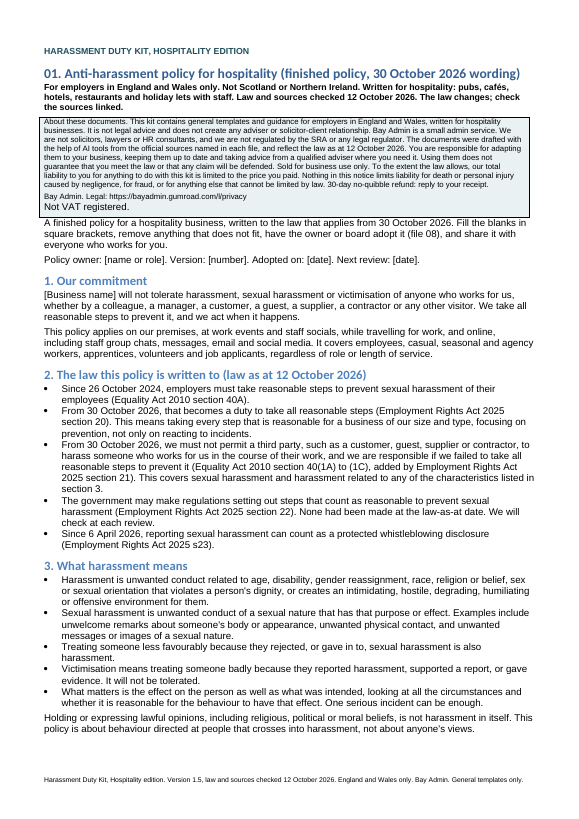
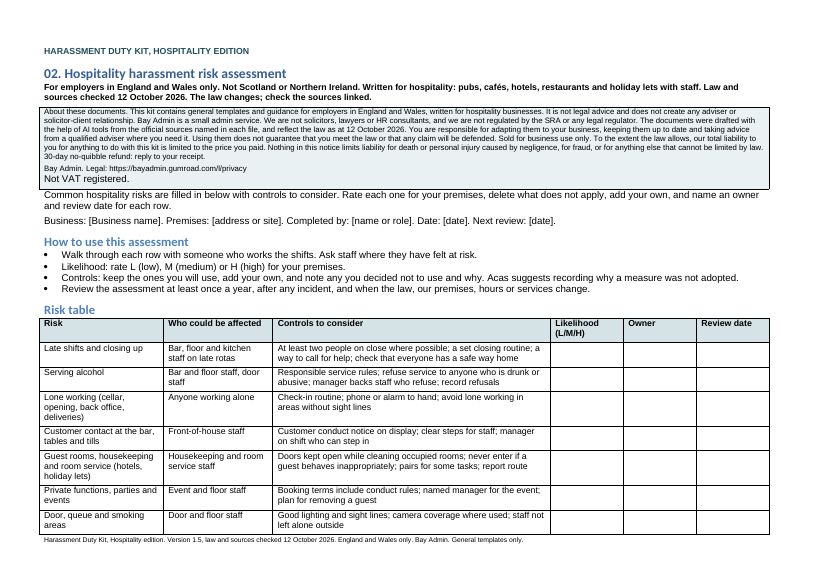
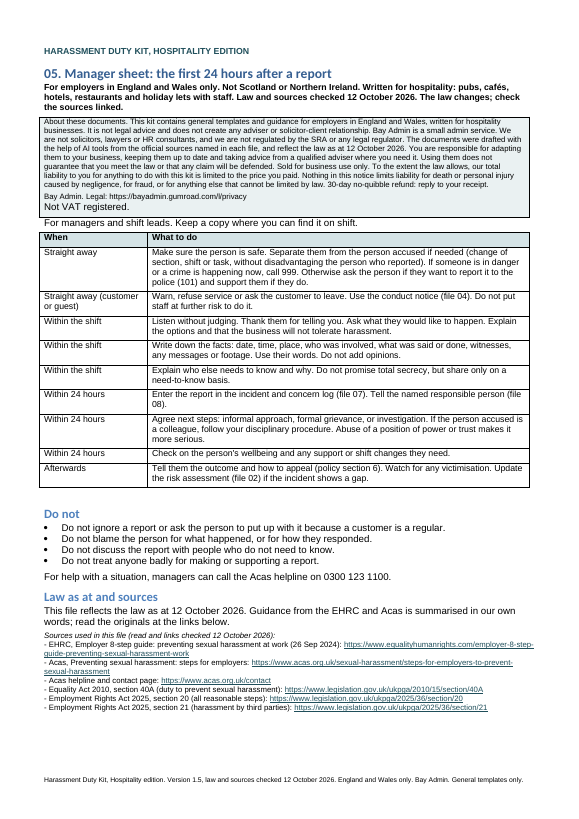
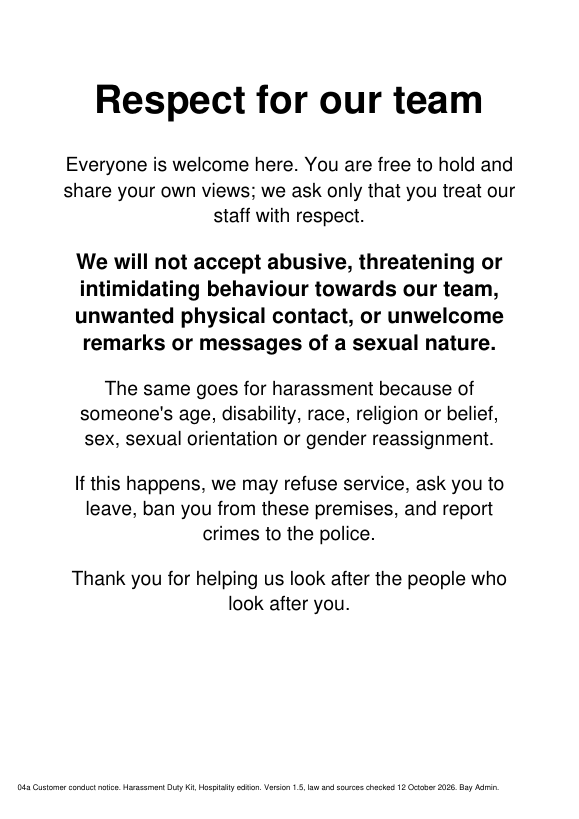
These are real first pages from the kit, shown small. You get every page in full, as editable Word files and print-ready PDFs.
Single site or up to 3 sites
| Single site | Up to 3 sites | |
|---|---|---|
| Price | £79 | £159 |
| Licence | One site | Up to three sites |
| Policy template | Yes | Yes |
| Risk assessment | Yes | Yes, plus example 3-site risk assessment |
| Action plan and customer conduct notice | Yes | Yes |
| Door and bar scripts, manager training, rollout plan | Yes | Yes |
| Incident, sign-to-confirm and training logs | Yes | Yes, plus cross-site briefing log |
| Editable files | Word, PDF, Excel | Word, PDF, Excel |
| Refund | 30 days, no quibble | 30 days, no quibble |
Multi-site questions
Can a pub group buy multiple licences?
Yes. The single site licence is £79. The licence for groups of up to three sites is £159. Both are available on the product page. For more than three sites, email bayadmin@mail.grokbot.com before you buy.
Is the kit suitable for multi-site operators?
Yes. The £159 licence covers up to three sites and includes an example three-site risk assessment and a cross-site briefing log. Each site still needs its own short notes on the risks that are real in that building.
Do we need a separate policy for each site?
A short core policy can be shared. Each site should still record its own risks and the steps taken there. The multi-site files in the £159 licence give a starting layout for that.
What if one site is a pub and another is a café?
The templates are written for small hospitality businesses in England and Wales. You adapt the risk notes to the real situations in each place. The paperwork is not legal advice.
How do we handle a purchase order?
Email bayadmin@mail.grokbot.com and we will send an invoice. 30-day no-quibble refund: reply to your receipt.
If a template file is faulty or is not as described, we will refund the purchase price within 30 days of the order. This covers the templates only and does not relate to any legal outcome or compliance result.